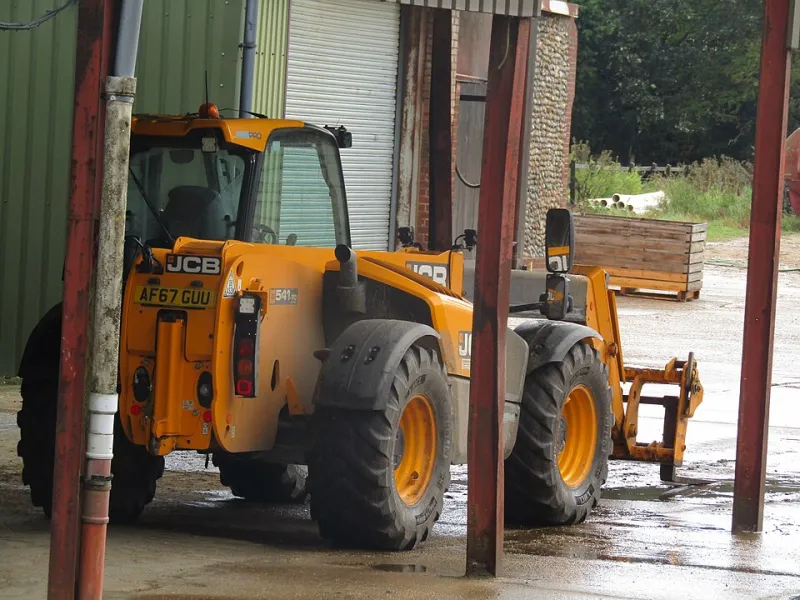
The Boundary of the Bonnet: Mapping In-House Repair Rights Across a Mixed Fleet
Photo: Internet Archive Book Images, No restrictions, via Wikimedia Commons
Ask a room of UK farmers whether they have a right to repair their own machinery and the answer will usually be an emphatic yes. Ask them to point to the provision that grants it for a 2026 tractor, telehandler or ride-on mower, and the room falls quiet. That gap between confidence and evidence is worth closing, because it shapes how a mixed fleet is specified, maintained and costed.
The honest position is this: the mechanical boundary of the bonnet has barely moved. The legal and electronic boundary has.
What UK law does, and does not, provide
The right-to-repair rules introduced in the UK in 2021 sit within the Ecodesign for Energy-Related Products and Energy Information Regulations. They impose spare-part availability and repair-information duties on manufacturers of specified domestic and electrical products. Agricultural and groundcare machinery is not in scope.
Nor does the motor vehicle block exemption, which gives independent garages access to technical information and tools for cars and light commercial vehicles, extend to tractors or telehandlers. Competition law offers general protections against abuses of dominance, but it is not a workshop manual.
In practice, what a UK operator can do to a machine is governed by three things: the sale contract, the warranty terms attached to it, and the technical means the manufacturer chooses to provide. That is a contractual permission, not a statutory right, and it is worth treating it as such when a purchase is being negotiated.
The three gates that actually decide the job
Software access. Diagnostics on modern machines run through a CAN bus and a manufacturer portal. Reading fault codes is often possible with a generic tool; clearing them, calibrating a transmission or completing an emissions regeneration sequence usually is not. Some brands sell time-limited subscriptions to their service platforms; others reserve certain functions for the dealer network. The difference between those two policies is worth more, over a machine's life, than a modest discount on the list price.
Warranty wording. A warranty is a contract, and contracts can be drafted widely. Clauses that require servicing to be carried out by an authorised dealer, or that exclude consequential loss following third-party work, are common and generally enforceable between businesses. That does not make them unalterable; it does make them worth reading before signing rather than after a failure.
Tooling and information. Workshop manuals, torque settings, wiring schematics and special tools are the quiet determinants of whether a job is a two-hour task or a two-day one. Availability varies considerably by brand and by dealer, and it is rarely advertised.
A framework for the mixed fleet
Most mixed fleets do not need a single policy. They need four, applied consistently. The distinction below is a starting point rather than a rule, but it keeps decisions out of the realm of habit.
| Category | Typical examples | Sensible default |
|---|---|---|
| Safety-critical systems | Braking, steering, suspension, ROPS structures, high-voltage components on electric groundcare machines | Dealer or a formally trained independent, with documentation |
| Software and calibration | Transmission calibration, engine derate resets, telematics provisioning, emissions after-treatment faults | Dealer unless a licensed service tool is held in-house |
| Warranty-sensitive work | Scheduled servicing on machines under manufacturer cover | Dealer during cover, with a planned transition afterwards |
| Routine and wear items | Filters, lubricants, belts, blades, tyres, hydraulic hoses, brake pads on trailed equipment | In-house, with a written record |
The value of the framework is not the categories themselves but the discipline of assigning each machine and each task to one of them before a failure occurs. A workshop that has already decided who does the 1,000-hour service does not debate it at 6am in harvest.
Questions to put to the dealer before signing
Procurement is the only point at which an operator has real leverage over repair access, and the questions are straightforward.
- Can I buy a service tool subscription for this model, and at what annual cost?
- Which diagnostic functions are reserved to the dealer network, and which are open?
- Will you supply the full workshop manual, including wiring schematics, on purchase?
- What exactly does the warranty require in terms of who performs servicing, and what happens if I use an independent?
- Are there restrictions on non-OEM parts, and do they affect goodwill claims?
- If I sell the machine, does any software or subscription transfer with it?
A dealer who answers these questions clearly is also signalling something about the after-sales relationship. One who deflects is signalling something else.
What good in-house practice looks like
Where a farm does keep work in-house, the difference between a defensible repair and a disputed one is usually documentation. A simple job sheet recording the fault, the diagnosis, the parts used, the technician and the date is enough to demonstrate reasonable care if a warranty claim is later contested. Photographs of a failed component before removal cost nothing and settle arguments quickly.
It is also worth keeping a small stock of genuine diagnostic consumables, such as filters and sensors specified for the model, rather than substituting equivalents on machines still under cover. The saving is rarely worth the conversation.
The direction of travel
The policy argument over repair access is not settled. Manufacturers point to emissions compliance, safety systems and intellectual property; operators point to downtime and to the proportion of a machine's life that falls outside warranty. Both positions have substance, and the UK has so far preferred voluntary arrangements to legislation in this sector.
That may change. In the meantime, the practical answer for a UK farm or contracting business is unglamorous: treat repair access as a specification item, record what you do, and decide the boundary before the breakdown rather than during it. The spanner is still yours to turn. The question is simply how far along the machine it will take you.