Six Thousand Hours and Counting: Deciding a Telehandler's Future on Evidence, Not Instinct
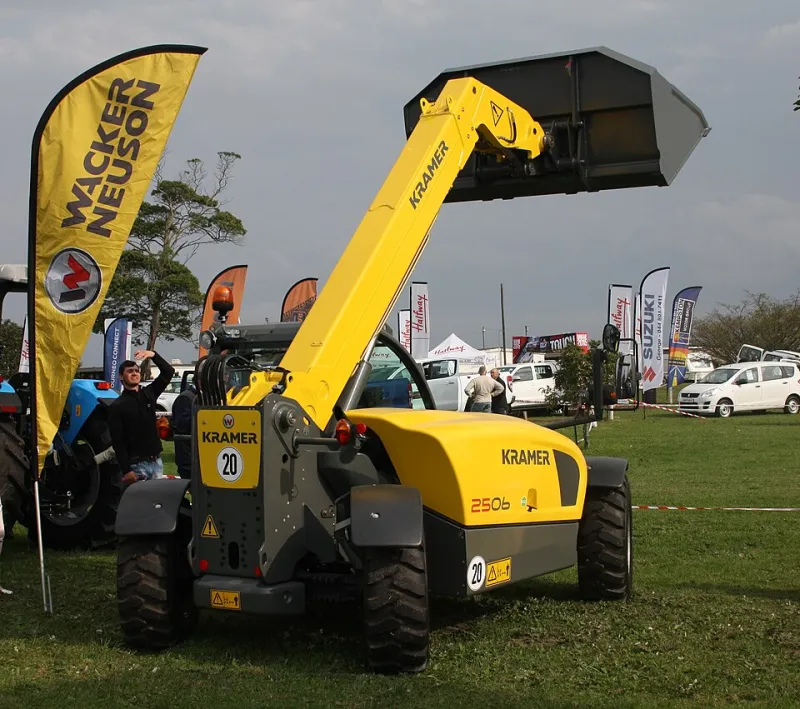
Photo: Jacquesbotha, CC BY-SA 4.0, via Wikimedia Commons
Telehandlers occupy an awkward place in the farm machinery fleet. They are worked hard, often by several operators, and they tend to accumulate hours faster than a tractor that spends part of the year on light duties. By the time a machine passes 6,000 hours, the question is no longer whether it will need attention but how much attention is economically sensible.
This is not a decision that can be settled by the hour meter alone. Two telehandlers with identical readings can be in very different condition depending on duty cycle, maintenance history and operator care. What follows is a framework for weighing major repair, full rebuild, replacement and short-term hire against one another — using the measures that matter to a UK farm or contracting business.
Why 6,000 hours is a marker, not a verdict
A telehandler that has spent its life lifting grain and straw on a mixed farm will usually have led a gentler existence than one that has been on a concrete plant or a busy livestock unit. Boom wear, hydraulic contamination, transmission condition and structural fatigue all vary with application. Service records, oil analysis and a competent inspection tell a more reliable story than the clock.
That said, 6,000 hours is a useful point at which to review the machine's role. In 2026, the cost of a major repair can be a significant fraction of a replacement's annual finance charge. The comparison is rarely straightforward, which is why a structured approach helps.
The four routes
Major repair addresses a specific failure — a boom section, a transmission, a hydraulic pump — while leaving the rest of the machine as it is. It is often the cheapest immediate option, but it can leave a machine with other components approaching their limits.
A full rebuild goes further: engine, transmission, hydraulics, boom and structural components are assessed and refurbished or replaced. The outcome can be close to a new machine in capability, though not in residual value, and the farm retains a machine it knows.
Replacement, whether with a new or late-used unit, brings warranty cover, current emission standards and a known starting point for maintenance. It also brings capital commitment or finance payments and, in many cases, a longer lead time than a repair.
Short-term hire is not a like-for-like alternative, but it can bridge a gap while a decision is made or a rebuilt machine is returned. For seasonal peaks, it may be the most rational answer of all.
A decision matrix that looks beyond the invoice
The purchase price or repair quote is only one line in the calculation. The table below sets out the factors that should sit alongside it.
| Factor | Major repair | Full rebuild | Replacement (new or late-used) | Short-term hire |
|---|---|---|---|---|
| Downtime | Days to weeks, depending on parts | Weeks to months | Lead time plus commissioning | Immediate, subject to availability |
| Resale value | Limited improvement | Modest uplift, but a rebuilt machine is still an older machine | Known market value and warranty | None — hire is a running cost |
| Warranty | Usually parts-only, short | Negotiable with rebuilder | Manufacturer or dealer cover | Covered by hire terms |
| Parts availability | Good for common models | Dependent on rebuilder's supply chain | Strong for current models | Dealer's responsibility |
| Whole-life cost | Low now, uncertain later | High now, predictable later | Highest commitment, most predictable | Highest per-hour cost, lowest commitment |
Downtime is the cost that rarely appears on a quote
For a contractor, a telehandler off the road during harvest or a busy livestock period can cost more than the repair itself. The relevant question is not simply how long the workshop will have the machine, but how long it will take to get parts, whether a loan machine is available and what the alternative arrangements will cost.
Dealers and independent mechanics should be asked for a realistic timetable, not a best-case one. It is also worth asking what happens if the strip-down reveals further damage. A repair quote based on an external inspection is an estimate, and a rebuild quote based on the same inspection carries similar uncertainty.
Residual values and the warranty question
A full rebuild can be economically attractive where the machine is structurally sound and the rest of the fleet is of a similar age. It preserves a known asset and avoids the transaction costs of replacement. But it does not turn an older machine into a new one in the eyes of the used market. If the business expects to sell within a few years, that matters.
Replacement brings warranty protection, which has a real value that is often left out of comparisons. For a high-hour machine used daily, the absence of warranty can be a false economy if a major component fails shortly after a repair.
Parts availability and the dealer relationship
Common models from established manufacturers generally have good parts support, but older machines can become dependent on specialist breakers. Before committing to a rebuild, ask the rebuilder how they source components and what lead times they have experienced. For a repair, check that the required parts are in the UK rather than on back-order.
Questions to put to dealers and independent mechanics
- What is the realistic downtime, including parts lead times?
- Is the quote based on an external inspection or a strip-down?
- What is the warranty on parts and labour, and what does it exclude?
- What is the likely residual value after repair or rebuild?
- Are there known weaknesses in this model at these hours?
- Can you provide references from similar machines?
- What would you do if this were your own machine?
Making the call
There is no universal answer. A clean, well-maintained machine with a sound structure may justify a rebuild; a machine with a history of electrical faults and a tired boom may not. The discipline is to compare the routes on whole-life cost, downtime and risk rather than on the size of the first invoice. That is the difference between a decision made on evidence and one made on instinct.